Available for remote collaborations, projects, and freelance work
Abdul Sami
I am a software developer specializing in blockchain infrastructure, distributed systems, and full-stack application development. My work focuses on building secure and scalable systems that combine blockchain technologies, data-driven analytics, and modern cloud-native architectures. Currently working in the blockchain space, I contribute to decentralized infrastructure while exploring the intersection of AI, data science, and distributed computing. I design systems centered on trust, transparency, and practical usability across healthcare, finance, and digital governance. I am always interested in collaborating on projects that push technological boundaries while delivering meaningful, measurable impact.
Skills
A snapshot of my technical strengths and the soft skills that power my work.
Technical Skills
TypeScript87%
JavaScript85%
Python82%
C++81%
Go68%
Rust65%
Solidity72%
React88%
Next.js86%
Tailwind CSS87%
shadcn/ui83%
Vite71%
Soft Skills
A balanced set of people-first capabilities that complement technical execution.
Communication
Problem Solving
Adaptability
Collaboration
Time Management
Critical Thinking
Accountability
Creativity
Decision Making
Leadership (emerging)
Mentorship (peer-level)
Empathy
Continuous Learning
Education & Certifications
B.Sc. · Information Technology
Bahria University Islamabad
GPA 3.13 / 4.00
2022 – 2026Islamabad, Pakistan
Project: HARMONY (A Healthcare System on Blockchain)
Coursework in AI/ML, Data Science, Web Development, App Development, Database Administration and Management
F.Sc. · Pre-Engineering
Bahria College Zafer Campus
2019 – 2022Islamabad, Pakistan
Marks: 845 / 1100
Coursework in Physics, Chemistry, Mathematics
Experience
FT
Software Trainee Engineer
Funavry Technology Limited–Islamabad, Pakistan
Contribute to blockchain infrastructure engineering and full-stack delivery across EVM and Cosmos ecosystems, with a focus on reliable deployments, protocol tooling, and production-ready backend services.
Built and tested blockchain network environments for EVM-based and Cosmos-based chains
Developed chain-focused components and custom on-chain/off-chain logic to support business workflows
Worked with Go, Rust, and Solidity to implement and validate blockchain-related features
Supported wallet integrations and blockchain explorer workflows for internal and external use cases
Engineered and maintained Node.js/Express backend services for blockchain-facing applications
Managed containerized deployments with Docker and supported cloud delivery pipelines on AWS
Handled operational tooling including binaries, environment setup, and release support for infrastructure services
Developed responsive web applications using React and Next.js, collaborating with senior developers on client projects.
Built 3 customer-facing features that improved user engagement by 25%
Optimized application performance resulting in 40% faster load times
Collaborated with UX team to implement accessible design patterns
ReactNext.jsTypeScriptTailwind CSSFigma
Featured Projects
A selection of my recent work showcasing different technologies and approaches.
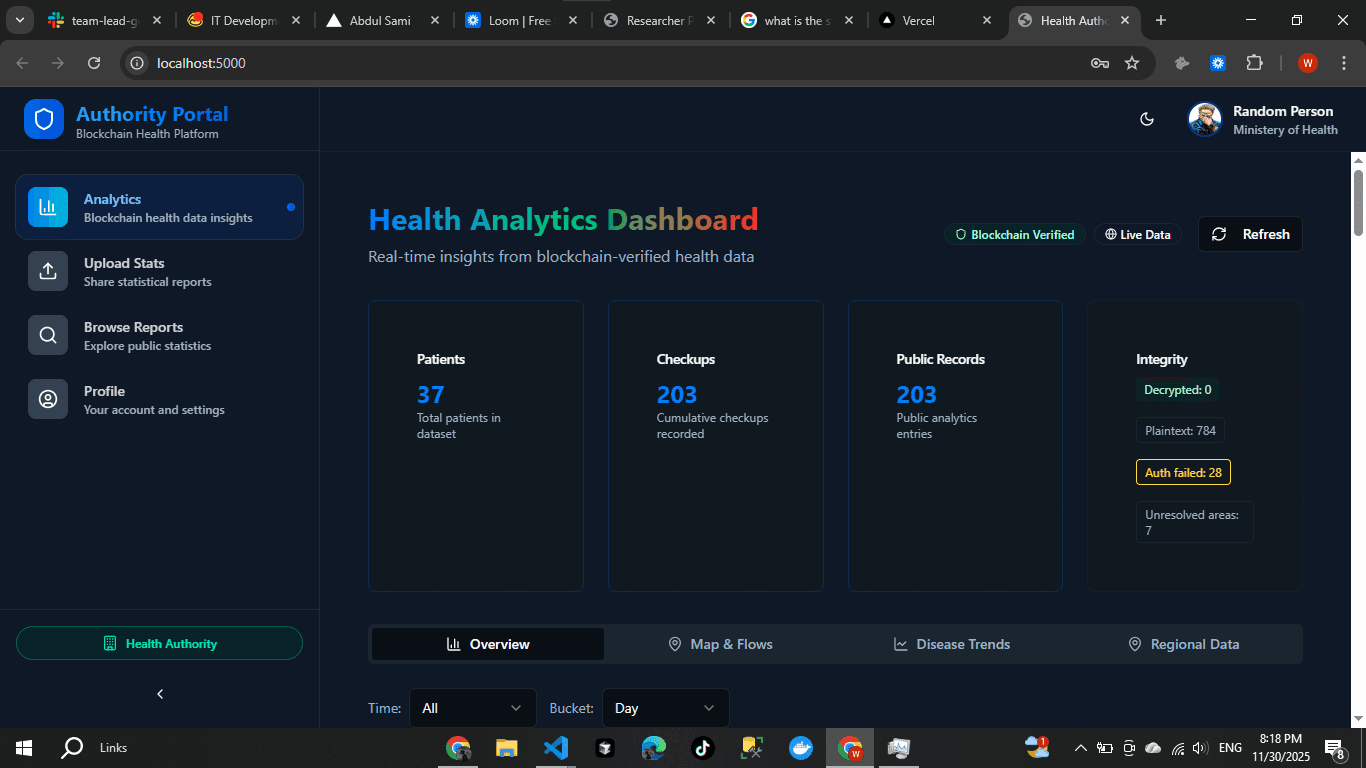
HARMONY Authorities Portal
A comprehensive web platform for health authorities to share statistical reports, analyze blockchain-secured health data trends, and make evidence-based public health decisions with real-time analytics.
ReactTypeScriptViteTailwind CSS+45
Tap for details
HARMONY Authorities Portal
HARMONY Authorities Portal empowers health authorities, government health departments, and public health officials with real-time analytics from blockchain-backed health records, enabling early outbreak detection, resource optimization, and evidence-based policy decisions.
Key Innovation
Combines blockchain immutability with selective field encryption, giving authorities verifiable health data while preserving patient privacy. No patient identifiers exposed. Fetches encrypted records from blockchain nodes → Decrypts with AES-256-GCM → Preprocesses (normalize, aggregate, analyze) → Visualizes in interactive dashboard.
Impact: Reduces surveillance lag from weeks to hours, enables predictive resource allocation, detects anomalies with statistical rigor (z-scores, diversity indices), and provides transparent data quality metrics.
Core Features
• Statistical Reports Management: Upload multiple file formats (PDF, Word, Excel, PowerPoint, Images) with rich metadata including categories, regions, time periods. Public/private visibility controls with file download tracking and analytics.
• Advanced Analytics Dashboard: Blockchain health data integration with disease surveillance monitoring, vaccination trend analysis, environmental health metrics, and real-time health alerts and notifications.
• Real-Time Analytics: Fetches encrypted records from blockchain nodes, decrypts with AES-256-GCM, preprocesses data (normalize, aggregate, analyze), and visualizes in interactive dashboards. Features 5-minute server-side caching with automatic fallback to probe snapshots.
• Advanced Visualization: Time-series trends, geographic heatmaps, Sankey flow diagrams, and anomaly detection. Interactive charts with bubble/heatmap toggle, bar/treemap toggle for drug analysis.
• Evidence-Based Decision Making: Statistical baselines, z-score analysis, diversity indices, and growth metrics for resource allocation and seasonal planning.
• Disease Surveillance: Automated spike detection (z > 3σ), emerging disease identification, and regional outbreak monitoring with 60%+ growth rate alerts.
• Data Integrity Verification: Transparent field-level provenance (decrypted vs plaintext vs auth-failed) with real-time integrity dashboard showing decryption success rates.
• Search & Discovery: Advanced filtering by category, region, time period with full-text search across reports and metadata. Trending reports discovery and authority profile browsing.
Technical Architecture
• Frontend Stack: React 18 + TypeScript + Vite with Tailwind CSS custom authority theme, Radix UI components for accessibility, Wouter for client-side routing, React Query for server state management, React Hook Form with Zod validation.
• Backend Stack: Node.js + Express.js with TypeScript, Supabase for database and authentication, Multer for file upload handling, UUID for unique identifiers.
• Database & Storage: Supabase PostgreSQL with Row Level Security (RLS). Three main tables: authority_profiles (user profiles with verification), authority_stats (statistical reports), authority_stats_comments (collaboration threads).
• Blockchain Integration: Read-only analytics consumer of blockchain-backed health data. Parallel HTTP requests to Hospital API (localhost:48080) and Authorities API (localhost:48083) with bearer token authentication. Field-level decryption using AES-256-GCM with HKDF-derived keys.
• Analytics Pipeline: Server-side processing with 5-minute cache TTL, automatic fallback to probe snapshots if blockchain unavailable, integrity tracking for decrypted/plaintext/auth-failed fields.
• Preprocessing Pipeline: 500+ lines of pure transformation functions including data cleaning (label normalization, null handling), time filtering & bucketing (day/week/month), statistical aggregations (moving average, Shannon entropy, z-scores), and flow analysis (Sankey diagrams).
Analytics Dashboard Features
• Overview Tab: KPI cards (total patients, checkups, public records), regional distribution bar charts, top diseases, diagnosis→drug mapping (stacked bar), diversity over time (line chart), field integrity dashboard, emerging diseases list, top drugs (bar/treemap toggle), patient flow metrics.
• Disease Trends Tab: Line chart mode with 7-day moving average and spike markers (red dots when value > MA × 2), stacked area mode for proportional view showing shifting disease composition.
• Map & Flows Tab: Geographic intelligence with bubble/heatmap toggle, diagnosis→drug Sankey flow diagrams, anomalies & alerts with data-driven tables and z-score analysis.
• Regional Tab: Area-specific metrics including record counts per area, geographic hotspots list, 7-day growth by area, diversity per region (Shannon H).
Statistical Methods
• Moving Average (7-day): Smoothing time-series and detecting spikes
• Shannon Diversity Index: Measures disease diversity in region/time period (H = -Σ p_i ln(p_i))
• Regional Growth Percentage: Compares last 7 days vs prior 7 days
• Baseline Statistics (Z-Score): Number of standard deviations from baseline (z = (latest/days - μ) / σ)
• Spike Detection: Detected when latest > MA × (1 + factor)
Security & Privacy
• Row Level Security (RLS) policies for data isolation
• JWT-based authentication with Supabase
• File upload validation and virus scanning
• Rate limiting and CORS protection
• Secure file storage with access controls
• AES-256-GCM envelope encryption with authenticated encryption
• Zero PII exposure - no patient identifiers visible to authorities
Key API Endpoints
• Authentication: /api/auth/register, /api/auth/me, /api/auth/profile
• Statistics: /api/stats/upload, /api/stats/public, /api/stats/my-stats, /api/stats/:id
• Analytics: /api/analytics/overview, /api/analytics/personal, /api/analytics/trending, /api/analytics/live (with force refresh support)
• File Upload: /api/upload/avatar, /api/upload/files
Refresh Strategies
• Manual Refresh: Authorities click button → hits /api/analytics/live?force=1 → server bypasses cache, fetches fresh blockchain data → React Query refetches, UI updates immediately
• Login-Triggered Refresh: Silent background refresh after authentication
• Hourly Auto-Refresh: Silent updates every 60 minutes with fallback to cached snapshot on failure
How This Helps Authorities
• Early Outbreak Detection: Detect disease spikes within hours, not weeks (z-score analysis triggers automatic alerts)
• Resource Allocation: Deploy resources to regions with 60%+ growth rates first
• Seasonal Planning: Predict staffing needs 2-3 months ahead using 90-day baseline comparison
• Disease Diversity Monitoring: Identify underserved areas for health equity initiatives (Shannon entropy per region)
• Drug Utilization Review: Identify prescribing patterns for clinical guidelines validation
• Data Quality Assurance: Real-time integrity dashboard with field-level provenance
This project demonstrates expertise in building secure, privacy-preserving public health surveillance systems that combine blockchain immutability with advanced analytics, statistical rigor, and evidence-based decision support for government health officials.
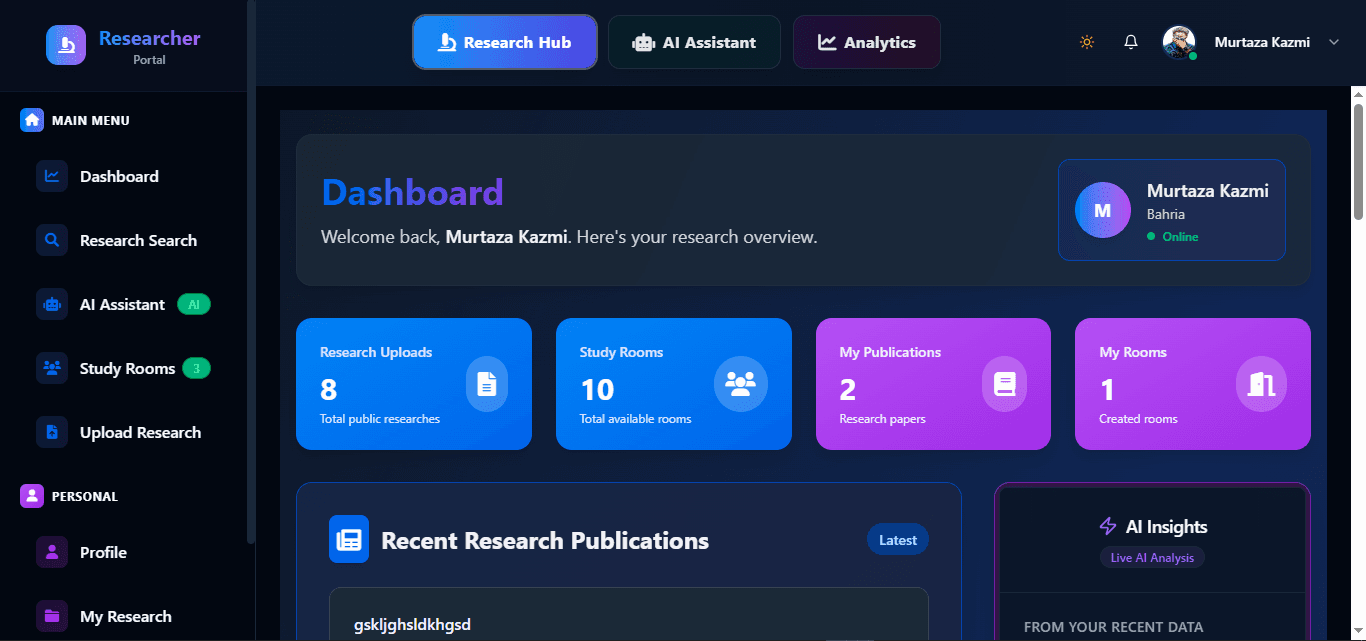
A comprehensive medical research platform integrating blockchain-based health records, AI-powered analytics, real-time collaboration, and encrypted data management for healthcare researchers.
ReactTypeScriptViteTailwind CSS+26
Tap for details
HARMONY Research Portal
HARMONY Research Portal is an advanced medical research platform designed to bridge the gap between blockchain-secured healthcare data and actionable research insights. Built as an extension of the HARMONY healthcare system, this portal empowers researchers, medical professionals, and health authorities with privacy-preserving analytics, AI-powered research tools, and collaborative study environments.
Core Features
• Blockchain Integration: Connects to a Hyperledger Fabric network with four organizations (Hospital, Pharmacy, Research, Authorities) running dedicated API containers. All medical data is immutably stored with envelope encryption (AES-256-GCM) and accessible only through controlled endpoints.
• Real-Time Health Analytics: Dynamic analytics dashboard featuring temporal disease trends, geographic distribution, treatment effectiveness analysis, and disease-symptom co-occurrence patterns. Data flows from blockchain through decryption layers and caching services with 1-hour refresh cycles.
• Anonymization & Privacy: Implements minimum count thresholds (rare categories suppressed), label truncation, tri-state rendering for encrypted fields, and zero PII exposure. CNIC hashes never leak; all queries use keyword-based search.
• AI-Powered Research Assistant: Integrated Groq API (llama-3.3-70b-versatile) and HuggingFace inference for research paper summarization, medical Q&A, data analysis insights, and literature review assistance. Features 30-minute caching and automatic retry with exponential backoff.
• Study Rooms (Real-Time Chat): WebSocket-based instant messaging with public/private rooms, member management, room settings, and live notifications. PostgreSQL storage for rooms, memberships, and messages.
• Research Paper Management: Upload PDFs/DOCX with metadata (title, authors, tags, abstract), version control, peer review commenting, tagging system, and full-text search. Supabase storage backend with signed URLs (10-minute expiry) and 50MB file size limit.
• Advanced Analytics System: Service layer fetches raw blockchain data, decrypts envelope fields using master key, normalizes labels, aggregates counts, and caches snapshots by time window (today/week/month). Returns structured snapshots with totals, geographic distribution, top diseases, symptom/prescription correlations, and decryption diagnostics.
Technical Architecture
• Frontend: React 18 + TypeScript + Vite with Tailwind CSS, shadcn/ui, and Radix UI components. Recharts for data visualization (Bar, Line, Pie, Area charts).
• Backend: Node.js + Express REST API with JWT-based authentication, bcrypt password hashing, and role-based access control (Researcher/Admin roles).
• Database: PostgreSQL with Drizzle ORM for schema management and migrations.
• Storage: Supabase file storage for research papers with path structure <userId>/<researchId>/<filename>.
• Blockchain: Hyperledger Fabric private network with envelope encryption for all medical records. Master key derived via HKDF-SHA256 for analytics-only decryption.
• AI Integration: Groq API primary model with HuggingFace fallback, in-memory caching, and rate limiting.
• Real-time: WebSockets for study room messaging and live notifications.
Security & Compliance
• Data Encryption: AES-256-GCM envelope encryption at rest via blockchain envelopes with per-field keys and AAD.
• Access Control: Role-based permissions enforced at API layer with JWT token validation (7-day expiry).
• Anonymization: No PII in analytics; CNIC hashes only used for blockchain queries.
• Input Validation: Zod schemas on frontend and server-side validation for all endpoints.
• File Upload Security: Type and size restrictions, signed URLs for downloads, virus scanning integration-ready.
Key Endpoints
• Blockchain: /patient/register, /patient/vitals, /patient/checkups, /patient/history/:cnicHash, /stats/basic, /research/keyword, /authorities/stats
• Analytics: /api/analytics/snapshot (time window support), /api/analytics/insights (AI-generated)
• AI: /api/openai/chat, /api/openai/summarize, /api/openai/analyze-research
• Study Rooms: /api/study-rooms (CRUD), /api/study-rooms/:id/messages, /api/study-rooms/:id/members
• Research: /api/research (upload/list), /api/research/:id/comments, /api/research/:id/versions
This project demonstrates full-stack expertise in building secure, scalable healthcare research platforms that prioritize data privacy, researcher collaboration, and actionable medical insights through cutting-edge blockchain and AI technologies.
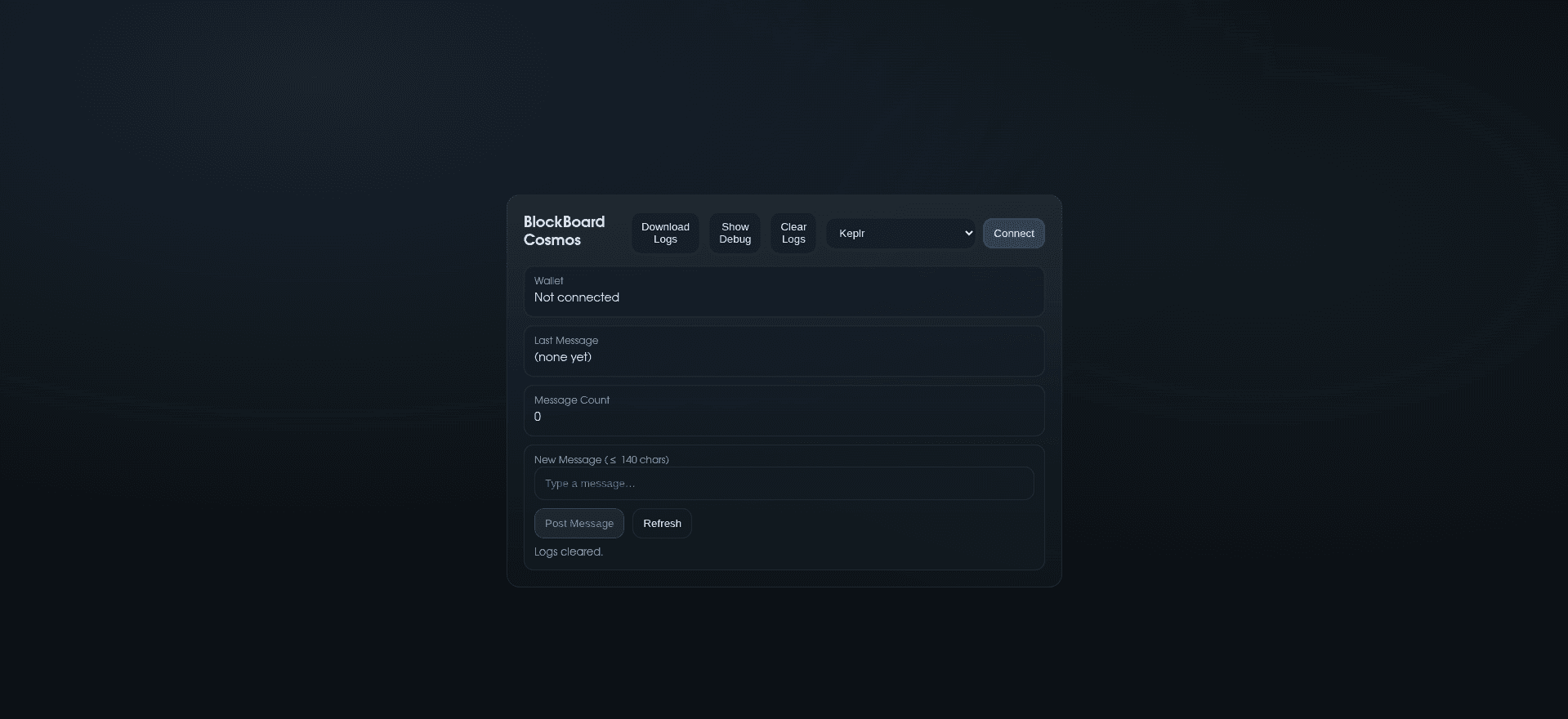
BlockBoard Cosmos is a practical blockchain engineering project built to demonstrate deep Cosmos-native development skills while preserving strong frontend product quality. The core objective is to implement a simple but complete decentralized application: users connect a wallet, post a short message to chain, and immediately read updated on-chain state (last message and message count).
From an architecture perspective, the project follows a clean, production-aligned pattern. The frontend (React + Vite) acts as a thin client using CosmJS for all blockchain interactions. Wallet signing is abstracted through Cosmos Kit adapters to support both Keplr and MetaMask (Leap Cosmos Snap), enabling a modern multi-wallet UX without introducing backend custodial logic. The blockchain backend is a local CosmWasm-enabled wasmd chain running in Docker, configured with deterministic local development behavior and exposed RPC/REST endpoints for rapid iteration and testing.
The smart contract is implemented in Rust using CosmWasm conventions: typed execute and query messages, explicit state management, and predictable validation rules. The execute path enforces message quality constraints (including length limits) and emits state transitions that are queryable from the UI. This demonstrates clean contract API design, safe state updates, and deterministic behavior under transaction execution. The query path provides efficient read endpoints for UX rendering, making it straightforward to build responsive interfaces around on-chain data.
The project also demonstrates strong developer-experience practices expected in professional teams. It includes repository segmentation by concern (contracts, frontend, local-chain, docs, scripts), local-first setup flow, deployment documentation, and helper scripts for funding and testing. The frontend enforces required environment configuration at startup to prevent silent runtime misconfigurations, which is a valuable reliability pattern for collaborative engineering environments.
A key differentiator is wallet interoperability. Beyond standard Keplr support, the app integrates MetaMask through the Leap Cosmos Snap pathway. This reduces onboarding friction for Ethereum-native users while preserving Cosmos transaction semantics and bech32 account behavior. The UI can present Cosmos addresses and derived Ethereum-style display addresses, helping users understand identity mapping across ecosystems and improving product accessibility for mixed-wallet audiences.
This project is portfolio-relevant for blockchain and full-stack roles because it proves capability across all critical layers: chain operations, contract engineering, wallet integration, RPC/REST usage, transaction lifecycle handling, and frontend UX reliability. It reflects hands-on delivery skills rather than isolated code snippets, and it demonstrates the ability to ship and operate an end-to-end decentralized product in a realistic development workflow.
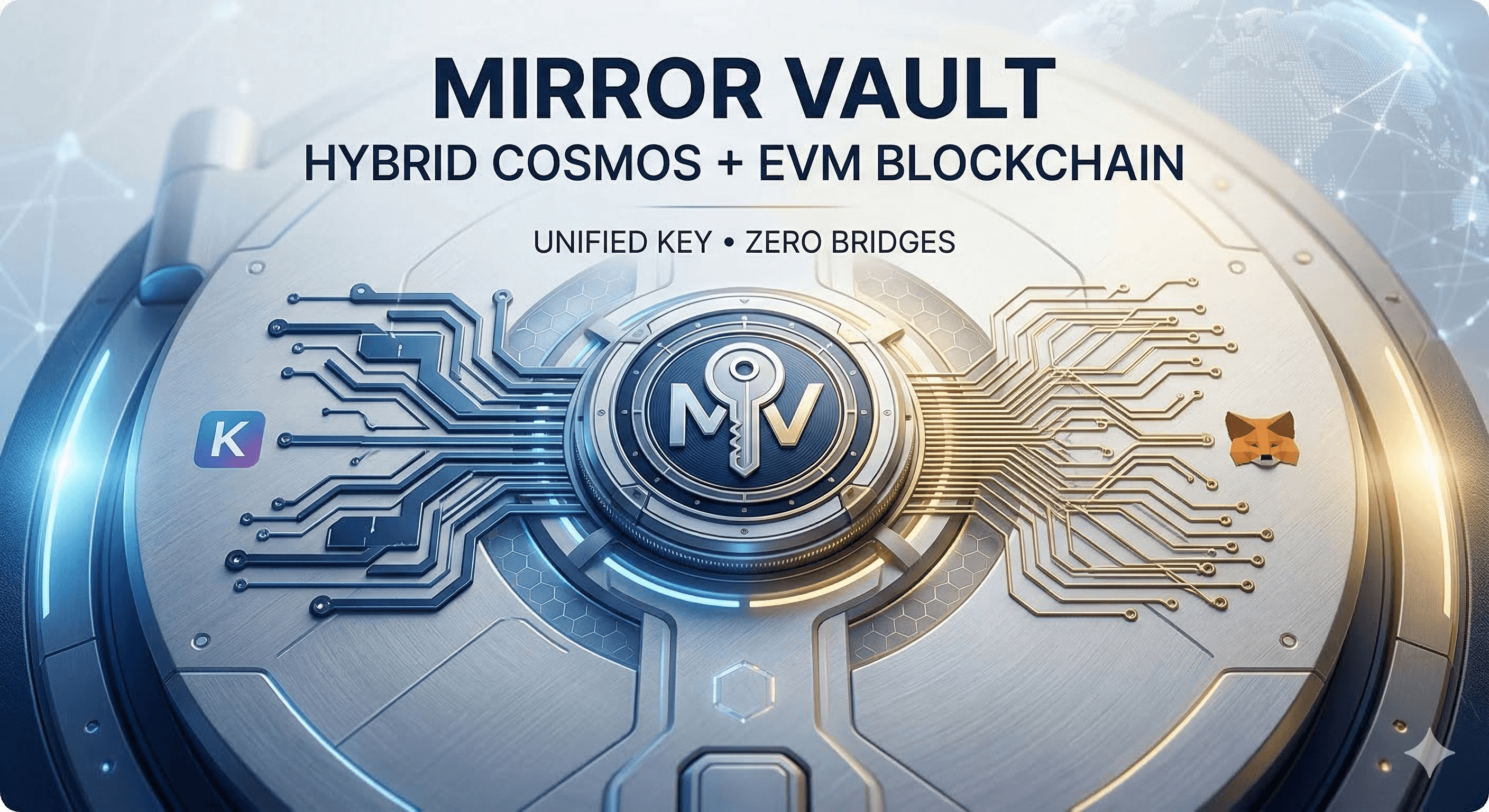
A custom Cosmos SDK blockchain that unifies Cosmos and EVM identities so one private key controls both mirror1... and 0x... addresses without bridge-based complexity.
Mirror Vault is a hybrid Layer 1 blockchain built to solve ecosystem fragmentation between Cosmos-native applications and EVM-based applications. Instead of forcing users to manage separate wallets, keys, and bridge workflows, the chain is designed around a unified identity model where one private key controls both a Cosmos bech32 address (mirror1...) and an Ethereum hex address (0x...).
Core Value
Mirror Vault combines Cosmos SDK performance and modularity with Ethereum smart contract compatibility on the same chain. This enables teams to build high-throughput native modules in Go while still delivering familiar Solidity/Web3 experiences for wallets and dApps.
Key Features
• Unified Identity Mapping: A single BIP-44 key derivation path with EthSecp256k1 enables synchronized Cosmos and EVM addresses with shared account ownership semantics.
• Hybrid Execution Model: Cosmos SDK modules handle canonical state and protocol-level logic, while Cosmos EVM executes Solidity contracts and exposes Ethereum-compatible behavior.
• Bridgeless UX: Users can interact through Keplr and MetaMask without relying on wrapped assets and cross-chain bridge flow for basic asset visibility and account operations.
• Native + Smart Contract Flexibility: Performance-critical logic can be implemented in Cosmos modules, while composable user-facing logic is delivered via Solidity contracts.
Technical Architecture
• Consensus Layer: CometBFT (Tendermint) provides BFT finality with configured low-latency block production.
• State Layer: Cosmos SDK powers account, bank, staking, and distribution modules, with custom module extensions for domain-specific logic.
• EVM Layer: Cosmos EVM (Ethermint) integration enables EVM execution and Ethereum JSON-RPC compatibility for wallet and tooling support.
• Identity Layer: Address mapping aligns Cosmos and EVM identity surfaces from the same cryptographic key material.
Implementation Highlights
• Operational Cosmos chain with validator setup, funded test accounts, and verified transfer flow.
• Reproducible build system with isolated Go toolchain and environment standardization scripts.
• Stabilized module wiring and genesis configuration for denom consistency, module accounts, and runtime initialization.
• Active development on manual EVM keeper wiring, JSON-RPC enablement, and cross-VM interaction paths.
Engineering Challenges Solved
• Resolved Go toolchain and dependency compatibility constraints for Cosmos/EVM builds.
• Addressed dependency-injection conflicts in EVM signer wiring through provider-based initialization patterns.
• Fixed EVM module account initialization issues by explicitly configuring required module account permissions.
• Eliminated bond-denom mismatches to keep staking and token economics consistent across genesis and runtime.
Roadmap
• Complete Cosmos EVM integration and validate end-to-end MetaMask compatibility.
• Implement custom x/vault module and Solidity VaultGate contract for business-grade encrypted data and access workflows.
• Add cross-VM precompile path for Solidity-to-Cosmos module invocation.
• Deliver a Next.js dashboard for unified account visibility, transaction flows, and cross-VM UX.
This project demonstrates advanced blockchain engineering across consensus systems, state-machine architecture, cryptographic identity design, EVM interoperability, and production-focused infrastructure practices.
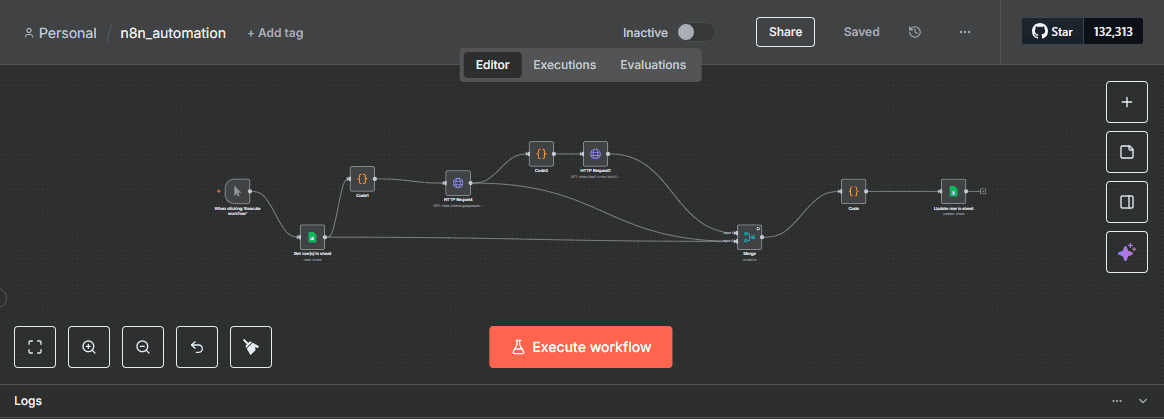
Lead Enricher Pro is a no-code data enrichment pipeline built in n8n. Starting from basic company details in Google Sheets, the workflow automatically discovers official websites, enriches profiles with social links (Facebook, Instagram, TikTok, LinkedIn, Yelp, YouTube, X/Twitter), and verifies executive contacts via Hunter.io.
Search queries are generated per company to improve precision, results are validated and cleaned in lightweight Code nodes, and everything is merged into a consistent structure. The final output writes back to the source Google Sheet in real time—saving hours of manual prospecting and research.
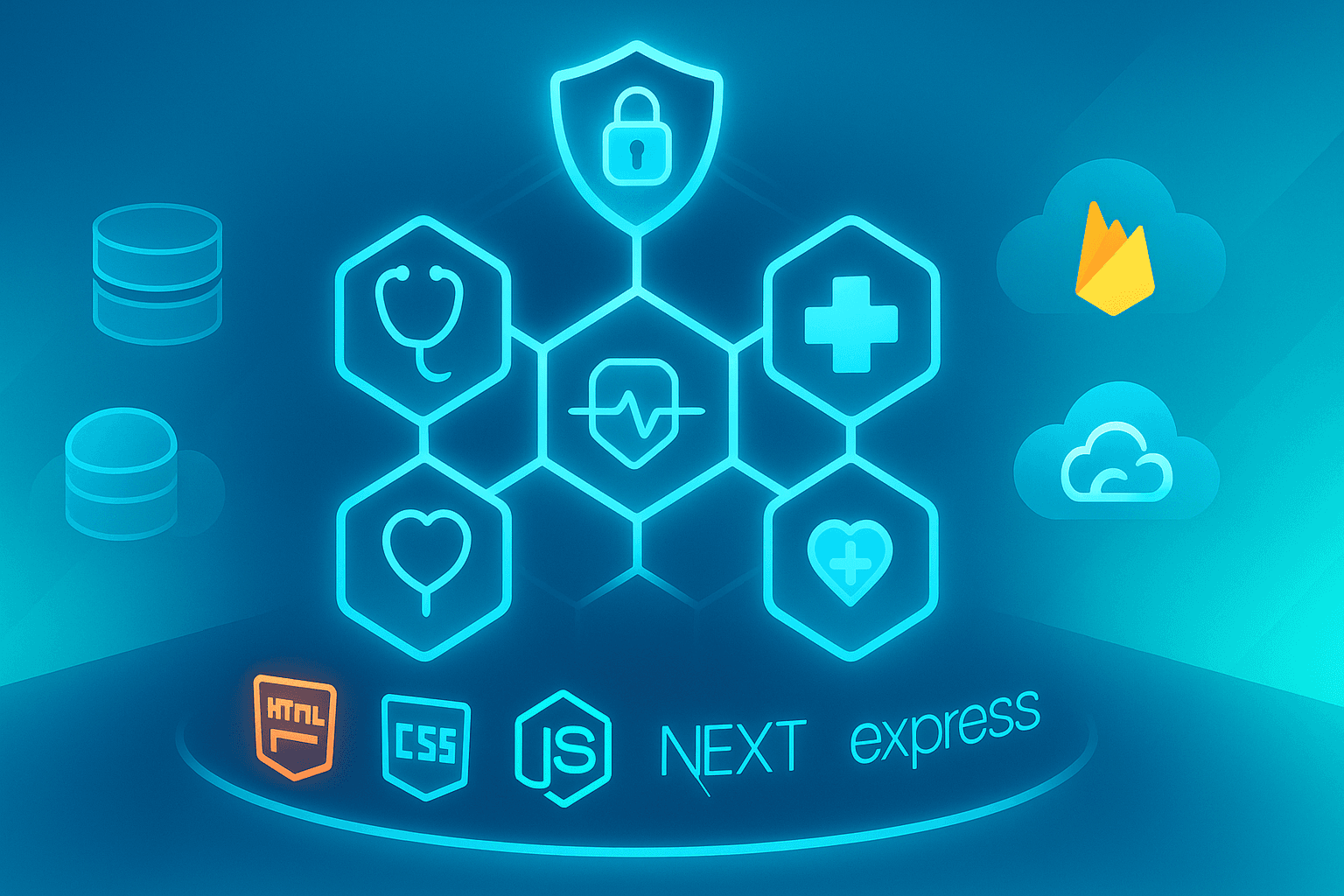
HARMONY: Healthcare, Administration & Research Managed On Blockchain Yield
A comprehensive healthcare and research management system built on blockchain for secure, transparent, and efficient operations.
HTML5CSS3JavaScriptReact (Next.js)+22
Tap for details
HARMONY: Healthcare, Administration & Research Managed On Blockchain Yield
HARMONY is my final year project aimed at addressing critical challenges in the healthcare sector by leveraging blockchain technology. Traditional healthcare systems often face issues such as data breaches, mismanagement of patient records, lack of transparency in research data, and administrative inefficiencies. HARMONY tackles these problems by introducing a decentralized platform where patients, doctors, administrators, and researchers can interact seamlessly while ensuring data security and trust.
The system enables patients to have complete control over their medical records, granting access only to authorized healthcare professionals through smart contracts. Hospitals and administrators benefit from streamlined workflows such as appointment scheduling, billing, and inventory management, all while reducing the risk of fraud and human error. Researchers gain access to anonymized, verified datasets, fostering collaboration and innovation without compromising patient privacy.
By integrating blockchain with AI/ML and data science principles, HARMONY ensures predictive analytics for patient care, transparent data sharing for researchers, and efficient decision-making for administrators. The goal is not only to secure sensitive healthcare data but also to build a system that promotes accountability, reduces redundancies, and improves the overall quality of healthcare delivery.
This project highlights my ability to design, architect, and implement a full-fledged solution that bridges multiple domains—healthcare, blockchain, artificial intelligence, and administration—while addressing real-world challenges with cutting-edge technology.
HTML5CSS3JavaScriptReact (Next.js)+22
Let's Work Together
I'm always interested in new opportunities and interesting projects. Feel free to reach out!